
The Zero-Risk Mindset: Why Proof Beats Confidence with Japanese Buyers

Japanese shoppers read every review, cross-check comparisons, and look through related posts before buying.
Risk-Aversion Slows Japanese Buyers Down
Two separate signals point the same direction:

Cultural disposition — Japan scores among the highest of any country measured on Hofstede's Uncertainty Avoidance Index, a widely used cross-national measure of discomfort with ambiguity.
Behavioral evidence — Nielsen's Global Survey of New Product Purchase Sentiment (29,000 respondents, 58 countries) found Japanese shoppers among the least likely to switch brands just to try something new — 23%, versus 60% globally.
The higher the price or the more premium the positioning, the more a buyer reads before deciding.
Both point to the same reframe:
Stuck between options ❌ → Ruling out the risk of choosing wrong ✅
A Confident Pitch Still Leaves Wary Buyers Uncertain
A pitch built on confidence — "the best," "industry-leading," a single strong claim delivered with conviction — is designed to resolve indecision. It gives a hesitant buyer a reason to pick one option over another.
Their hesitation is about whether choosing at all, from an unfamiliar brand, is safe — . A confident pitch does little to resolve that.
Hypothetical example — a DTC skincare brand entering Japan leads with "trusted by 500,000 customers worldwide" and a confident founder testimonial:
In a market where hesitation = which product to pick → the pitch differentiates, and works
In Japan, where hesitation = can I trust this company at all → the pitch answers a question the buyer wasn't asking
The brand's own language does the same work in reverse.
Marketing copy that reads as machine-translated, or just slightly off, doesn't register as a minor polish issue to a buyer already scanning for reasons not to trust an unfamiliar company — it reads as one more reason.
Third-Party Proof Lowers the Risk
What actually addresses risk-aversion is evidence that someone other than the brand has already tested the water:
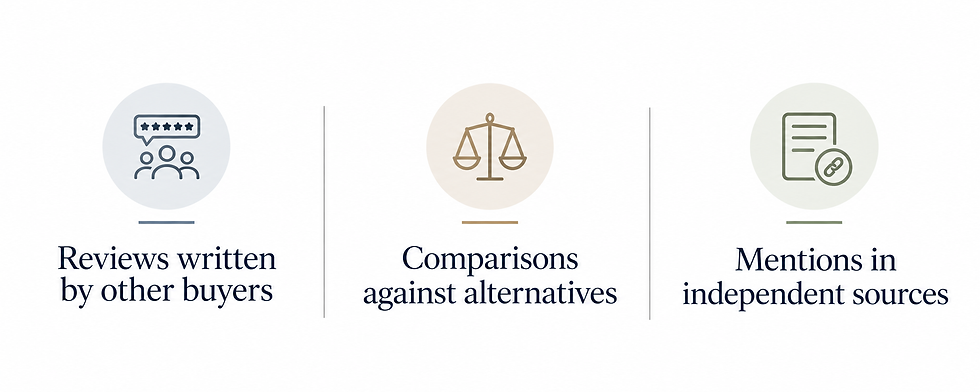
They carry weight precisely because none of them come from the company — someone else already took the risk first.
A Larger Body of Proof Builds More Trust
One 5-star review = an outlier
A large, varied body of reviews = a pattern other people already checked
The absence of proof reads just as clearly as its presence. A brand that's barely visible in conversation — few reviews, little real-world mention on social media — leaves a wary buyer with nothing to check the claim against, which is its own kind of risk signal.
Proof Is the Finish Line
For a brand relying on social media to build initial awareness in Japan, this changes what the SNS-to-purchase journey actually needs to accomplish.
Where the gap usually opens up:

That proof has to live on whatever the buyer lands on next — a product page, a review section, a comparison piece. Without it there, the discovery moment is wasted.
Worth checking:
when someone lands on your site after seeing your brand on social media, is the next thing they see proof that other people already made this choice — or is it another version of the same pitch?
Comments